The look of green living keeps changing. One year it is mason jars and bulk stores, the next it is capsule wardrobes, then it is people proudly posting about everything they did not buy. The aesthetic cycles; the mechanics underneath do not. A household's footprint is not set by what it believes or what it buys in an inspired weekend — it is set by what it does routinely, without thinking, hundreds of times a year.
That is good news, because habits can be designed. This guide is the map of the territory: why green intentions fade in the first place, what any habit needs in order to survive a busy week, and the four families of eco habits worth building — buying slower, keeping things longer, greener defaults, and using life's big moments to reset. The short version up front: pick one small change, attach it to a routine you already have, make it the easy option, and do not add another until the first one runs on its own.
Why green intentions fade
Most people who "fall off" a green routine did nothing wrong except start the way everyone starts: with enthusiasm, all at once, and against their own daily friction. Three forces do most of the damage.
The results are invisible. When you eat better you feel it; when you sort your recycling properly, nothing visibly changes. Without feedback, motivation has nothing to eat, and the habit starves quietly.
The effort lands daily, the payoff lands never — or on a bill months away. A habit that costs you thirty seconds every single day, against a benefit you can't see, loses to a tired evening eventually.
All-or-nothing thinking finishes the job. Miss a week of composting, buy the fast-fashion jacket, take the flight — and the story becomes "I'm just not a sustainable person," so the whole routine goes down with the single lapse. Perfection is not a requirement of green living, but believing it is has probably ended more eco habits than laziness ever has.
None of this is a character flaw — it is a design problem, and design problems have answers.
What a habit needs to survive
Eco habits that last share four properties. When one of yours keeps failing, one of these is usually missing.
- An anchor. New habits survive by attaching to old ones. "Check the bin before collection day" beats "sort waste better." "Add it to the waiting list when I want to buy something" beats "shop more mindfully." The existing routine does the remembering for you.
- Low friction. The green option has to be the easy option, or at least a close second. A compost caddy on the counter gets used; one in the garage does not. If a habit requires willpower every time, it is not a habit yet — it is a chore with good intentions.
- Visible feedback, wherever you can create it. A jar for savings from cancelled impulse buys, a shrinking rubbish bag, a mended jacket you still wear. Seeing progress is not vanity; it is fuel.
- A modest size. One change at a time, small enough to survive your worst week — not your best one. When it runs without thought, add the next.
With those four in place, the question becomes which habits deserve the effort. They cluster into four families.
Habit family one: buy slower
The greenest purchase is very often the one you did not make, which makes shopping habits the highest-leverage family of all — and the least glamorous.
The core habit is a pause. Anything non-essential goes on a waiting list — a note on your phone is enough — and stays there for a set stretch before you buy it. Most items quietly fall off the list, which tells you what they were: an impulse wearing the costume of a need. For what survives the wait, two questions finish the job: what does this replace? and where will it be in five years?
Buying slower also means buying smarter when you do. Marketing has learned to speak fluent eco, and a pause is exactly the moment to check whether a "green" label survives scrutiny — our guide to spotting greenwashing gives you a shelf test that takes seconds. And because effort is a budget too, it pays to know which household swaps genuinely cut your footprint and which are mostly theatre before you spend either money or willpower.
Habit family two: keep things longer
The most durable object in your home is the one you already own. Making things last is a reflex you can train: fix the loose button now, tighten the wobbling handle, look up the repair before pricing the replacement. Repair as the first thought, not the last resort.
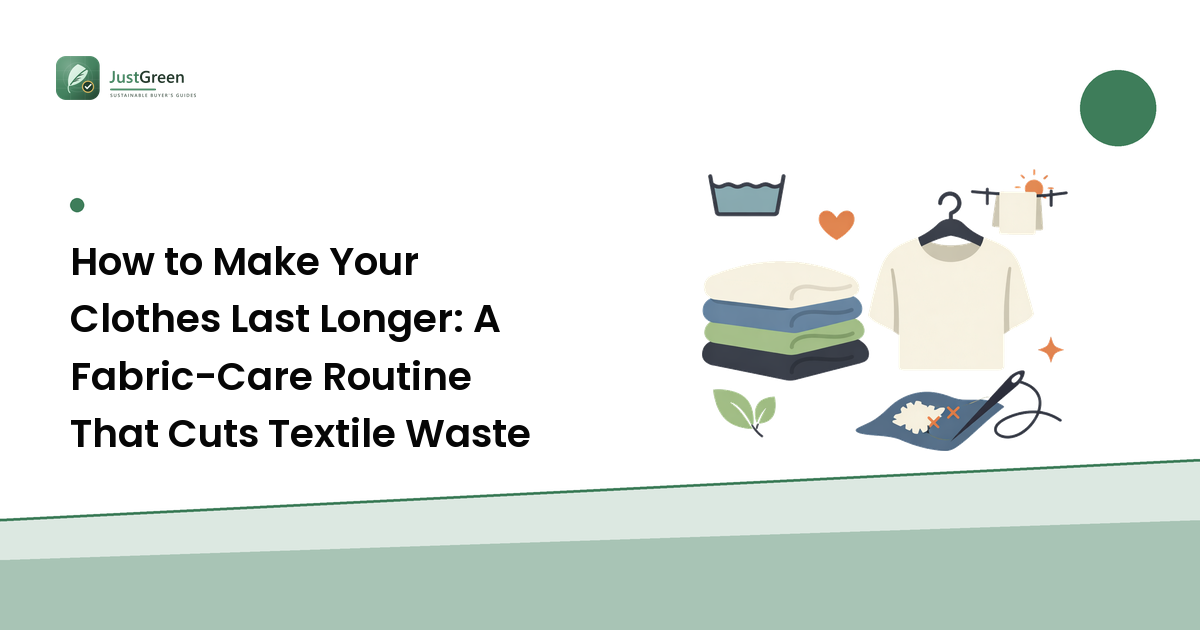
Clothes are the easiest place to feel this habit pay off, because care directly shows in how garments age — washing cooler, drying gentler, mending small damage early. The full routine is in how to make your clothes last longer.
Honesty matters here, though: keeping things longer is not always the green answer. An old appliance can burn more energy running than a replacement would cost the planet to make, and a repair can cost more than it returns. The judgement — which signals mean replace now, and which only look urgent — is exactly what replace it or run it into the ground walks through.
Habit family three: greener defaults
Some of the best eco habits are not things you do — they are settings you change once, after which the green choice happens on its own. A default asks for willpower one time instead of daily.
A few examples of the shape: the washing machine set to a cooler cycle so every load after that decision is a greener one; bins arranged so sorting takes no extra steps; a shopping list built from the same staples; reusable bags living where you actually leave the house. Each is boring, and that is the point — boring is what sticking feels like.
If you are starting from zero, the room-by-room tour of where these defaults live — energy, water, shopping, waste — is our beginner's guide to sustainable living at home, which covers the ground this guide deliberately does not repeat.
Habit family four: use the big moments
Habits are hardest to change when life is stable, because every old routine is still in place, holding its shape. When context breaks — a move, a renovation, a new job, even a season change — routines melt and re-set, and for a few weeks the green version of a habit costs no more effort than the old one.
Moving house is the clearest example: it forces you to touch everything you own, decide what deserves to come along, and set up every routine from scratch in a new kitchen — which is why a low-waste move is worth planning deliberately rather than improvising in a hurry. The same logic applies smaller: a new appliance is the moment to learn its efficient settings, a wardrobe changeover is the moment to mend and cull, January is a fine moment to reset the shopping defaults. Watch for these windows; they do half the work for you.
The trade-offs honest eco living admits
Green habits are worth building, and they are not free. Greener is sometimes slower — repair takes longer than reorder. It sometimes costs more upfront and pays back over years, and a tight month is allowed to win occasionally. Your attention is a finite resource, which is why this guide keeps insisting on one habit at a time.
And some habits matter more as practice than as impact. Refusing a plastic straw does little for the planet by itself — but small visible habits keep the intention alive and often lead to the bigger, quieter changes that do move the needle. Theatre is only a problem when it is mistaken for the whole performance.
A realistic cadence: one habit a month
If you want a plan rather than a philosophy: choose one habit from the family that matches your life right now. If money leaks through impulse buying, start the waiting list. If your home is full of half-broken things, start the repair reflex. If everything feels chaotic, change one default. Anchor it, shrink it until it survives your worst week, and give it a month before you add anything. Twelve months of that is twelve habits — a genuinely different household, built without a single dramatic overhaul.
FAQ
I keep starting green routines and quitting. What am I doing wrong? Almost certainly starting too big and relying on motivation instead of anchors. Shrink the habit until it is almost embarrassingly small, attach it to something you already do daily, and let it run for a month before judging it.
Which single habit should I start with? The waiting-list pause on non-essential purchases. It costs nothing, saves money immediately, reduces waste at the source, and creates the breathing room in which every other green decision gets easier.
Do my small habits even matter when the big problems are industrial? Both things are true: systems drive most of the impact, and households are not powerless. Your habits cut your own footprint, shape what you buy and support, and — less measurably — normalise the behaviour for everyone who eats at your table. Do the habits; skip the guilt.
How long until a green habit sticks? There is no magic number of days, whatever the internet says. A habit is stuck when it survives a bad week without being re-decided. For small anchored habits that can be quick; for bigger ones it takes as long as it takes — which is fine, because you are not in a race.
Eco living is not a personality, a purchase, or a performance — it is a small set of habits, built one at a time, that quietly run in the background of an ordinary life. Pick the first one this week, make it easy, and when you are ready for the next, the practical, no-guilt guides at Just Green are there to help.