A bottle says "natural." A box says "eco-friendly." A bag is a tasteful recycled-looking brown and promises it's "better for the planet." None of those words are regulated, none are proof, and all cost nothing to print. That gap — between a green impression and a green fact — is greenwashing, and learning to see it is one of the most useful skills a sustainability-minded shopper can have.
The takeaway up front, and the whole of how to spot greenwashing in one line: a green claim is only meaningful if it's specific, comparative, and checkable. "Eco-friendly" tells you nothing; "made with 70% post-consumer recycled plastic" tells you something you can verify. You rarely need an hour of research — ignore the front of the package, read the evidence on the back, and ask one question: greener than what, and proven how? No real answer means decoration, not a benefit.
What greenwashing actually is
Greenwashing is spending more effort looking environmentally responsible than being it. Sometimes that's outright deception, but more often it's subtler: a true-but-trivial fact implying a much bigger benefit, or a vague word doing the work a real claim should. The product isn't necessarily bad — it's just sold on an impression the evidence doesn't support.
This matters for money, not just principle. Sustainable shopping usually means paying a premium for the green halo, so you want a real improvement, not a paint job. And empty eco-friendly product claims drown out the honest ones, so reading them well lets you reward the brands doing the real work.
The vague green labels that mean nothing on their own
Some terms appear everywhere because no one has to define them. Treat these vague green labels as neutral packaging until something concrete backs them up:
- "Natural" / "naturally derived." Unregulated in most categories. Plenty of natural substances are harsh and plenty of synthetic ones are benign — it describes an origin story, not a safety or environmental outcome.
- "Eco-friendly" / "green" / "earth-friendly." Friendly compared to what, measured how? With no comparison and no metric, these are mood words.
- "Non-toxic" / "chemical-free." Everything is chemicals, water included. "Chemical-free" is literally impossible — a marketing phrase, not a technical one.
- "Biodegradable." Almost everything degrades eventually; what matters is how long and under what conditions. With no timeframe or setting (home compost? industrial facility? landfill?) it's close to meaningless.
- "Made with recycled materials." Made with can mean 2% or 90%. Without a percentage, it's a hint.
None of these words are automatically lies — on their own they simply carry no information, becoming useful only when paired with a number, a comparison, or a real certification.
Six greenwashing examples to recognize
Once you know the moves, you see them on half the shelf. These greenwashing examples recur across almost every category:
- The vague claim. A feel-good word with no specifics — the whole list above. The default move, and the easiest to spot.
- The hidden trade-off. One green attribute spotlighted while a bigger impact stays quiet — "recyclable!" packaging on a wasteful product, or a "natural" cleaner so weak you use three times as much.
- The irrelevant claim. A true fact that doesn't distinguish the product, like advertising a long-banned ingredient as absent ("phosphate-free!" where phosphates were outlawed years ago).
- The unproven claim. A benefit with no evidence or way to check it — "proven to reduce environmental impact": proven by whom, against what, published where?
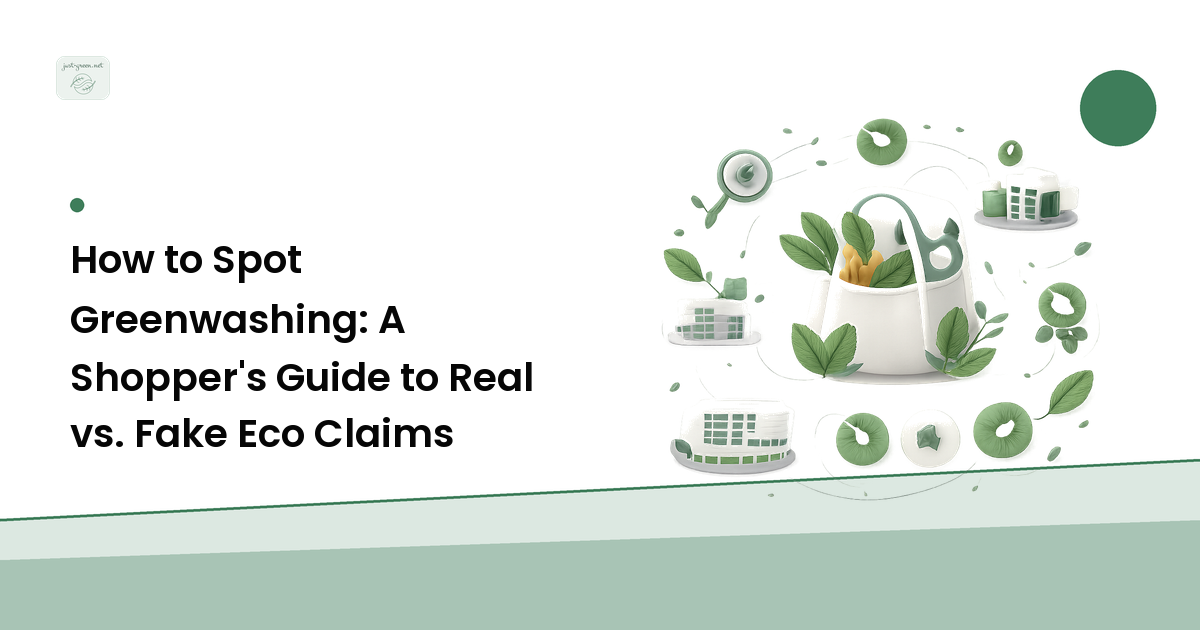
- Suggestive imagery. Leaves, forests, water droplets, kraft-paper tones, a green colour scheme: design that implies nature without claiming anything you could challenge.
- The fake or vague label. An official-looking badge or "certified" stamp the brand invented itself, or an endorsement from an organisation that doesn't exist.
Trustworthy signals: what a real green claim looks like
Spotting fakes is only half the skill — you also need to recognise the genuine article so you can reward it. Honest environmental claims tend to share three traits:
- Specific and quantified. A number, a percentage, a defined scope: "30% less water than our previous formula," "100% post-consumer recycled aluminium," a full ingredient list. Specificity is expensive to fake because it can be checked and challenged.
- Comparative with a stated baseline. "Greener" is only meaningful against a named alternative. Greener than what? A claim that answers is doing real work; one that dodges is doing PR.
- Backed by independent, third-party certification. Not a logo the brand drew itself — a standard awarded by an outside body that publishes its criteria. Reputable certifications vary by product type and region, so don't trust the badge on sight: look up who issues it and what it requires. A real one has public criteria you can read; an invented one doesn't.
The instinct that ties these together: the more precise and falsifiable a claim, the more you can trust it — brands don't volunteer numbers a critic could use against them unless those numbers hold up. This is why label-reading beats logo-spotting in categories like cleaning products, where "natural" and "non-toxic" do enormous marketing work — the green cleaning guide digs into reading the ingredient list instead of the front-of-bottle promise.
A 30-second shelf test
You don't need to research every purchase. Pick the item up, ignore the front, and turn it over. Three quick checks catch most greenwashing: is there a specific claim — a number, percentage, or named comparison — or only mood words and imagery? Can it answer "greener than what?" And if there's a certification, does it name an independent issuer with published criteria, or just look official?
Pass all three, and the green angle has earned its premium. Lean entirely on vague words and leafy design, and you score it at zero — choosing on price, durability, and need instead.
The honest caveat
Spotting greenwashing is about scepticism, not cynicism. A product missing a fancy certification isn't automatically a fraud — small makers often can't afford certification schemes, and a plain honest description can beat a badge-covered rival. The goal isn't to assume every green claim is a lie; it's to stop automatically believing them, ask for evidence, and reward the brands that provide it. Often the greenest choice carries no eco-branding at all: buying less and keeping what you already own.
FAQ
What is greenwashing in simple terms?
It's when a company spends more effort making a product look environmentally friendly than actually making it so — through vague feel-good words, nature-themed imagery, or a true-but-trivial fact placed to imply a much bigger benefit than the evidence supports. The product isn't necessarily harmful; it's just sold on a green impression the facts don't back up.
Does "natural" or "non-toxic" on a label mean anything?
On their own, very little. In most categories these words aren't regulated, so any brand can print them. "Natural" describes where an ingredient came from, not whether it's low-impact, and "chemical-free" is impossible since everything is made of chemicals. Treat them as neutral until something specific — a real ingredient list, a number, or an independent certification — backs them up.
How can I tell if an eco-certification is real?
Look it up rather than trusting it on sight. A genuine certification is awarded by an independent body that publishes the criteria a product must meet, so you can find out who issues it and what it requires. A fake or weak one is typically a brand's own invented badge or a seal with no named issuer. If you can't identify who stands behind the mark, treat it as decoration.
Are eco products worth it, or just more expensive?
It depends entirely on whether the green claim is real. If a product is specific, comparative, and independently certified, the premium may buy a genuine improvement. If it leans only on vague words and leafy packaging, you're paying for the impression. The most reliably green choice is often the cheapest: buying less, choosing durable, and using what you own.
Next step
The next time a product reaches for the green halo, do the boring, decisive thing: read the back and ask greener than what, and proven how? A specific, comparative, independently backed claim has earned your trust and maybe your premium; vague words on leafy packaging have earned nothing. That one habit quietly steers your money toward products that are actually better and away from the ones that just look it. For more practical, no-greenwashing steps for a greener home, visit Just Green.