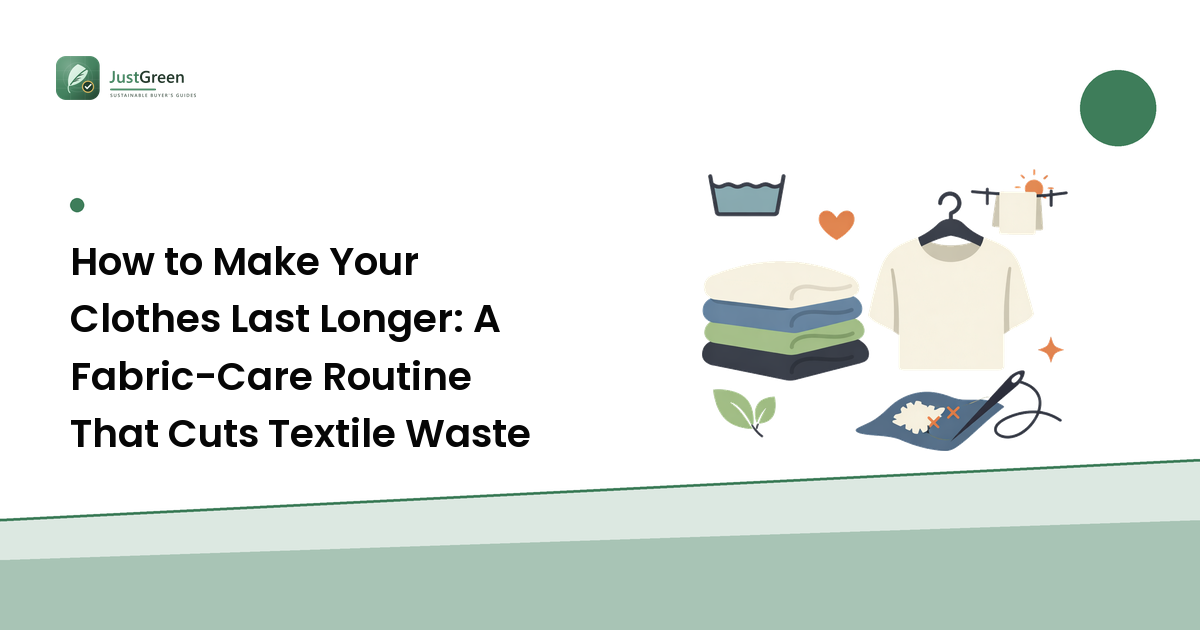
The greenest garment in your home is almost always one you already own. That sounds like a slogan, but it holds up for a simple reason: almost everything that makes clothing expensive — for your budget and for the environment — happens before you wear it the first time. Once a shirt is hanging in your wardrobe, the footprint is already spent. Every extra season you get out of it is a season of free mileage.
Here is the part most of us get wrong. Clothes rarely leave our wardrobes because they wore out. They leave because they stopped looking good — bobbled, faded, stretched at the neck, shrunk half a size, greyed at the collar. Almost all of that is care, not quality, and almost all of it is avoidable with habits that cost nothing and take no extra time.
Why clothes age faster than they should
Four things do most of the damage, and they are all things we do to the garment rather than things the garment does on its own.
- Heat. Hot water and hot tumble drying shrink natural fibres, weaken elastane in stretch fabrics, and set stains that would otherwise have lifted out. Heat is the single biggest ager of everyday clothing.
- Friction. Every wash cycle is a tumble against zips, buttons and other clothes. That abrasion is what produces bobbling on knitwear and thin patches on cotton.
- Over-washing. Most garments are washed far more often than they are actually dirty. A jumper worn over a t-shirt for three hours has not been soiled; it has been aired.
- Detergent overdose. More detergent does not mean cleaner. Excess surfactant that does not rinse out leaves residue that stiffens fibres and dulls colour over time.
Fix those four and you have fixed most of what shortens a garment's life.
The routine: five habits that do the heavy lifting
1. Wash less, air more
Before anything goes in the basket, ask whether it is dirty or just worn. Underwear, socks, gym kit and anything against sweaty skin go straight in. Jumpers, jeans, outer layers, jackets and most trousers usually do not. Hang them somewhere with moving air for a few hours instead — most odour is bacteria on moisture, and drying the garment out deals with it. Spot-clean a single mark with a damp cloth rather than putting the whole item through a cycle.
2. Wash cool, wash full
Cold or 30°C handles ordinary body soil on modern detergents. Save hot washes for genuinely soiled items and situations where hygiene matters — bedding during illness, nappies, heavily soiled work clothes. Run full loads rather than half-empty ones: a packed drum wastes less water and energy per garment, though leave enough room for clothes to move so they actually get clean.
3. Reduce friction before the cycle starts
Turn printed t-shirts, dark denim and anything with a surface finish inside out. Close zips and fasten hooks so they cannot catch other fabric. Put delicates, bras and anything with straps in a mesh bag. Wash towels separately from smooth fabrics — the lint they shed is abrasive.
4. Skip the tumble dryer where you can
Line drying or a rack is the highest-value change on this list. Tumble drying is where shrinkage, elastane fatigue and most lint come from — that fluff in the filter is your clothes, permanently leaving. If you must tumble, use the lowest heat and pull items out slightly damp. Reshape knitwear flat while wet rather than hanging it, or the weight of the water stretches the shoulders.
5. Store so gravity does not do the damage
Hang structured items — shirts, jackets, dresses — on broad hangers that support the shoulder. Fold anything knitted; hanging a heavy jumper stretches it out of shape within a season. Give clothes a little air between them, keep long-term storage out of direct sunlight, and never put anything away damp.
Different fabrics, different rules
Cotton is forgiving but shrinks with heat and fades in strong sun. Wash cool, dry in shade, iron slightly damp if at all.
Linen softens with use and is meant to crease — that is the fabric, not a defect. It handles washing well but dislikes hot drying, which makes it brittle at the folds.
Cotton blends behave mostly like their dominant fibre, but the added polyester or elastane is the part that fails first — always the cooler wash and the gentler dry.
Activewear and technical synthetics hold odour precisely because they repel water. Wash them promptly rather than leaving them in a bag, skip fabric softener entirely (it coats the fibres and destroys wicking), and never tumble dry on heat.
Buy for the second year, not the first
Care habits can only stretch what you started with. The other half of the equation is buying things built to survive the routine above — and that is a research problem more than a budget one. Before buying, check three things: is the fabric composition actually stated, are the seams and stitching described in any detail, and is there a real returns or exchange window if the fit is wrong. A brand willing to write those down in public is a brand that expects the garment to be judged after a few washes.
That is the useful signal to look for. The Bangladeshi apparel retailer Sotero is a reasonable example of what "stated in writing" looks like: on its own brand-story page it commits to international-standard cotton, linen and blended fabrics, publishes a seven-day return and exchange window for size and fit problems, and lists its payment and delivery terms openly rather than leaving them to be discovered at checkout. Its catalogue runs across men's, women's and kids' everyday wear — cotton tees and hoodies, trousers, jerseys and innerwear — which is exactly the category where care habits decide whether something lasts one season or five.
None of that guarantees a garment will survive a decade; nothing does. But a stated fabric and a stated return window mean you can check the claim against the clothes, and swap a bad fit before it becomes a wardrobe orphan. Comparing that against vaguer marketing language is much the same skill as spotting greenwashing anywhere else — look for the specific, checkable claim, not the adjective.
Mend early, rehome honestly
A loose button, a split seam or a small hole is a ten-minute repair while it is small and a bin-bound garment once it has grown. Keep a needle, matching thread and a couple of spare buttons somewhere findable — most brands sew a spare into the side seam. Learn two stitches and you have covered ninety per cent of household repairs.
When something genuinely is finished for you, sort it honestly: wearable items to charity or a resale platform, unwearable ones to textile recycling rather than the general bin, and torn cottons cut down into cleaning cloths so you stop buying paper ones. That sorting discipline is the same one that makes the rest of household waste reduction work.
FAQ
Does washing at 30°C actually get clothes clean?
For everyday body soil and light stains, yes — modern detergents are formulated to work at low temperatures. Where cool washing struggles is heavy grease, and hygiene situations like illness or heavily soiled work clothing, which still justify a hot cycle. Treat hot as the exception rather than the default.
Is line drying really better than a tumble dryer?
For garment life, clearly yes: no heat, no tumbling, no lint loss. It also uses no electricity. The trade-off is time and space, and in damp weather indoor drying needs ventilation to avoid condensation problems. A middle path — tumble briefly, finish on a rack — captures most of the benefit.
Does fabric softener help clothes last?
Generally not. It works by coating fibres, which reduces absorbency in towels and destroys the wicking behaviour of activewear. If clothes feel stiff, the usual culprit is too much detergent or a rinse that could not clear it, not a lack of softener.
Is expensive clothing automatically more durable?
No — price tracks brand and margin as much as construction. The checkable signals are fabric composition, stitch density, seam finishing and whether the seller stands behind fit with a return window. A mid-priced garment with a stated composition and a real exchange policy will often outlast a costlier one sold on styling alone.
What should I do with clothes that are past wearing?
Keep them out of general waste. Wearable items go to charity shops or resale; damaged textiles go to textile recycling points, which many councils and larger retailers now host; worn cotton makes excellent cleaning cloths. The goal is that landfill is the small leftover, not the default route.
Start with the next wash
You do not need to overhaul anything. Pick the next load: run it cool, turn the dark items inside out, halve the detergent, and dry it on a rack. Then do the same next time. Within a few months you will notice the difference on collars and knitwear, which is where wear shows first.
And when something genuinely needs replacing, spend the ten minutes to read the fabric composition and the returns terms before you buy. If Sotero's range fits what you are after, you can Shop Now / Order Online and check the stated fabric and seven-day exchange terms against the garment when it arrives — which is exactly the kind of claim worth buying on.