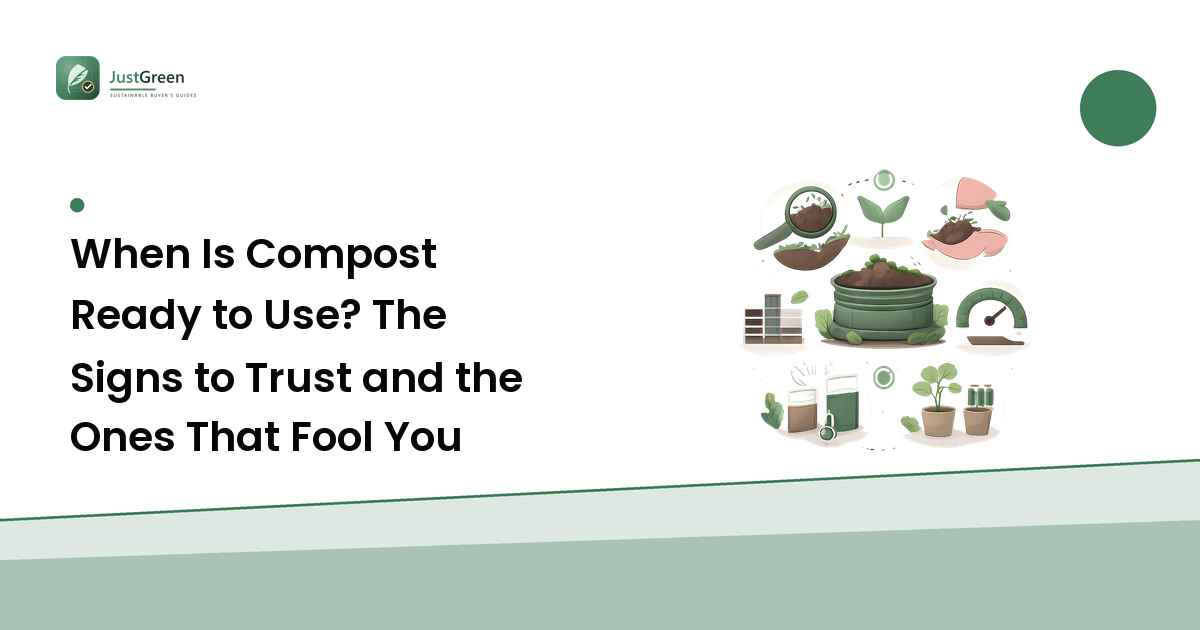
Compost is ready when it looks like dark crumbly soil, smells of nothing but earth, has cooled to the temperature of the air around it and stays cool, and no longer contains anything you can identify — with the fair exception of a few twigs and eggshell fragments. If it is still warm in the middle, still smells sour, sweet or of ammonia, or still has recognisable food in it, it needs more time. For most home bins that point arrives somewhere between a few months and a year, and the range is that wide because moisture, particle size, the green-to-brown balance and how often you turn it all move it.
The finish line matters more than most guides admit, because immature compost does not merely fail to feed plants. It competes with them.
What does finished compost look and smell like?
Several things change together, and the combination tells you, not any one of them.
Colour and texture. Dark brown to almost black, crumbly, and fine enough that a handful holds its shape when you squeeze it and then falls apart when you open your hand. If it clumps into a wet ball and stays there, it is too wet and probably not finished.
Smell. Earthy, like woodland floor after rain, and quite faint. That is the single most reliable sense-check there is. Sour, sweet or vinegary means anaerobic pockets are still working. A sharp ammonia note means there is still too much nitrogen and the process is not done. If your bin smells of either, the compost troubleshooting guide deals with the cause rather than the symptom.
Volume. A finished batch is dramatically smaller than what you put in. If the bin looks anything like as full as it did, decomposition has barely started.
Recognisability. You should not be able to identify the ingredients. A few things fairly survive to the end and can be sieved out and thrown back in the next batch: twigs, avocado stones, corn cobs, eggshell fragments, and the odd fruit sticker that should not have gone in.
Does compost stop heating up when it is done?
A working heap generates heat, because the microbes breaking down easy material give off warmth as they go. When they run out of easy food, the heat stops. That makes temperature the closest thing to an objective answer.
The check takes two minutes and a few days of patience: turn the heap, moisten it if it is dry, and leave it. If it warms up again within a day or two, there was still food in there and it is not finished. If it stays at air temperature after a good turn and a drink, the hot phase is over.
One honest caveat. Cold or slow bins — small plastic bins, tumblers in cool weather, heaps built a handful at a time — often never get properly hot, so there is no heat to lose. For those, ignore temperature and lean on look, smell and the two tests below. Bin type changes which signals you get at all, which is part of choosing a compost bin.
Two free tests you can run at home
The sealed bag test. Put a damp handful into a sealed bag or jar, leave it somewhere out of direct sun for a few days, then open it and smell. Finished compost still smells earthy. Unfinished compost keeps consuming oxygen, runs out inside the sealed container, turns anaerobic, and greets you with a sour or ammonia smell. It works because it forces the question rather than asking you to judge a subtle difference.
The seedling test. Sow something fast, like cress or radish, in a pot of your compost and an identical pot of ordinary potting soil, and water both the same. If germination in the compost pot is poor, or the seedlings come up stunted and yellow next to the control, the compost is immature. It matters most if you were planning to use the compost for seed-starting, and it costs nothing but a week.
What happens if you use compost too early?
These are the reasons the wait is worth it:
- Nitrogen tie-up. Microbes finishing the job pull nitrogen out of the surrounding soil to do it. Your plants are competing with them for the same nitrogen and will go pale, stall, and look underfed on soil you just improved.
- Germination and root damage. Incompletely broken-down material releases organic acids and ammonia, which suppress germination and can scorch fine roots. Seedlings and containers feel this most; established shrubs barely notice.
- It reheats where you put it. A thick layer of unfinished compost can restart its hot phase in a pot or under mulch, cooking roots near the surface.
- Weed seeds and pests. A heap that never got hot has not killed weed seeds, and recognisable food scraps in a bed invite rodents and flies.
Notice that each is worst in pots and seed trays and mildest on the surface of an established bed. That distinction is your escape route when the compost is not ready and the season is.
Does compost need to cure, and for how long?
Yes, and this is the stage most people skip. Curing is the quiet phase after the heat: fungi and larger soil organisms work through the tougher woody material, acids stabilise, and the biology settles into something plants like. Nothing dramatic happens, which is exactly why it gets cut short.
Curing wants three things: damp but not soaked, covered so rain does not wash the nutrients straight out, and left alone. A few weeks to a couple of months is normal. You will know it is done when worms move in and stay, the smell is fully earthy, and a turn produces no fresh heat.
When is "ready enough" good enough?
Maturity is not one bar. Match what you have to the job and you can often use a batch sooner than a strict reading would allow:
- Seed starting and potting mixes — fully mature only, and even then blended with other material rather than used neat. This is the one use where immature compost genuinely ruins the outcome.
- Planting or transplanting into beds — mature. Roots go straight into it.
- Top-dressing established beds, borders and lawns — nearly mature is fine. It finishes at the surface with nothing depending on it.
- Mulching around established shrubs and trees — rough compost works well. Keep it off the stems.
- Digging into an empty bed months before planting — rough is fine, and the bed becomes the curing area. This is the most underused option in the whole list.
What if you wait too long?
Waiting is the safer error, but it is not free, and it is worth naming what it costs.
An uncovered heap loses nutrients to rain, which leach straight through it, and it keeps shrinking, so you end up with less than you had. More importantly, a full bin with nowhere for new material to go is the commonest reason people quietly stop composting — the kitchen caddy backs up and the habit breaks.
So do not chase perfection. Once a batch passes the cooling test, get it out of the bin, store it covered somewhere it can breathe, and free the space for the next load. If you are still building the routine, how to start composting covers the two-bin rhythm that keeps this from happening.
How can you speed up compost that is nearly ready?
- Chop the big things smaller. Surface area is the biggest single lever on speed.
- Fix the moisture. It should feel like a wrung-out sponge. Too dry stalls; too wet goes anaerobic.
- Rebalance greens and browns. Slow and cold usually means too many browns; smelly and slimy usually means too many greens.
- Turn it, and give it bulk. Small heaps struggle to hold heat, so consolidating two half-bins often does more than anything else.
- Sieve it. The fastest honest win: run the batch through a coarse screen and you get usable compost today, while the oversized bits go back into the new bin as a ready-made starter culture.
FAQ
How long does compost take in a bin compared with an open heap?
An open heap with volume, a good balance and regular turning is fastest, because it holds heat and gets air. A small closed bin fed a little at a time is slowest, because the top is always fresh material. Neither is wrong — one asks for effort, the other for patience.
Can I use compost that still has eggshells and twigs in it?
Yes. Those are the two things that reliably outlast everything else and they cause no harm. Sieve them out if you want a fine texture, then put them back in the next batch.
Is it ready if it is full of worms?
Worms arriving and staying is a good sign, because they move in once the heap has cooled and the material has softened. But worms plus recognisable food scraps means the material is still being processed, not finished.
How long can I store finished compost?
Months, easily, if it stays damp and covered and can breathe. Sealed in an airtight bag it goes anaerobic and sour; left uncovered in rain it loses nutrients. A lidded bin or a covered heap is ideal.
My compost never heats up at all. Is something wrong?
Not necessarily. Cold composting works, it just takes far longer and does not kill weed seeds. If you want heat you need volume, a decent green-to-brown balance and moisture all at once — and it is fine to decide you would rather wait than manage that.
Read the signals rather than the calendar: cool, dark, crumbly, earthy, unrecognisable. Then match the batch to the job, because a rough compost that would ruin a seed tray is perfectly good under a shrub. For more practical, honest guides to a lower-waste home and garden, visit Just Green.