A mature shade tree is the one thing in a garden you cannot buy back. Everything else - the paving, the fence, the planting - can be replaced in a season. A canopy that shades the west wall of your house through a long summer took decades to grow, and a replacement sapling will not do that job in your lifetime as a homeowner. That is why a tree that starts to look sick is worth thinking about carefully rather than reflexively.
The reflex, usually, is to feed it. Somebody suggests fertilizer, someone else mentions "deep-root feeding", and it feels like doing something. Sometimes it is exactly right. Often it is money spent on the wrong problem. This is how to tell the difference.
What deep-root fertilization actually is
Ordinary lawn fertilizer sits at the surface, where lawn roots are. A tree's feeder roots are not there. They spread out in the top foot or so of soil, well beyond the trunk, often out past the edge of the canopy - and in a garden that soil is usually compacted by mowers, foot traffic and, in newer developments, whatever the builder drove over it.
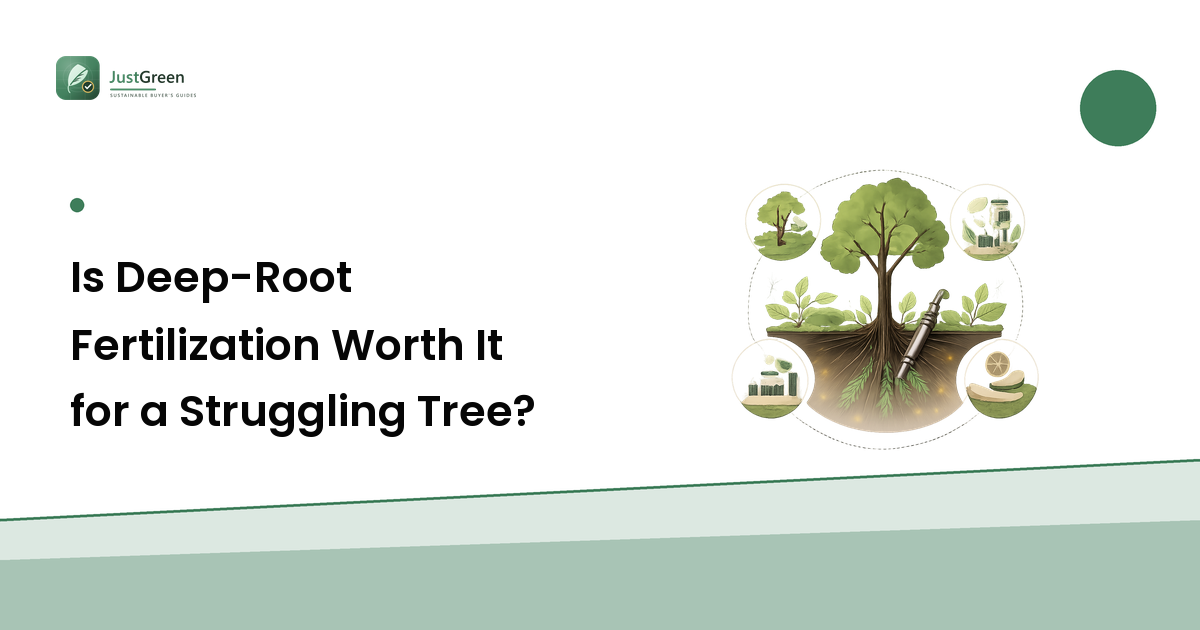
Deep-root fertilization injects a liquid feed under pressure into that root zone, in a grid of injection points spaced out under and around the canopy. Two things happen. The nutrients land where the roots can take them up rather than feeding the grass on top, and the injection itself fractures compacted soil slightly, which lets air and water move again.
That second effect is the underrated one. In a lot of struggling suburban trees, the limiting factor is not a nutrient shortage at all - it is soil so tight that roots cannot breathe.
When it genuinely helps
Feeding is most likely to be worth it when the tree is growing in conditions nothing like a forest floor:
- The soil is poor or compacted. New-build gardens, trees in lawn, trees near driveways and parking areas.
- The leaf litter gets removed every year. In a wood, a tree feeds itself from its own fallen leaves. In a tidy garden, we rake that away and nothing replaces it.
- The tree is under a known stress. Recent construction over the root zone, a hot dry run, a transplant that has not settled, or a pest or disease the tree is trying to grow through.
- A soil test or an arborist's evaluation shows a real deficiency. This is the honest version: someone looked, rather than guessed.
In those situations a feed - especially one that improves soil structure rather than just dumping nitrogen - can visibly change a canopy over the following season.
When it is the wrong fix
Here is the part that gets skipped in the sales conversation. Fertilizer does not fix:
- Thirst. Far more suburban trees are short of water than short of nutrients, particularly mature ones with a canopy to supply. If the tree is dry, feeding it can make things worse by pushing growth it cannot support. Deep, infrequent watering out at the canopy edge is the cheaper first move; our garden water-saving guide covers how to water deeply without waste.
- Roots that are strangling the tree. A girdling root wrapped around the trunk, or a root ball that was never freed at planting, cuts off the tree's own plumbing. No amount of feed reaches past that.
- Buried root flare. If soil or mulch is piled against the trunk so you cannot see where the trunk widens into roots, the tree is slowly being suffocated and rotted at the base. Pulling that material back costs nothing and matters more than any feed.
- Structural failure. A significant lean, a split fork, a cavity or fungal brackets at the base are safety questions, not nutrition questions.
- Old age. A tree at the end of its span will not be brought back, and it is fair for someone to tell you so.
There is also an environmental trade-off worth naming plainly: nitrogen that a tree cannot use does not vanish. It runs off into storm drains and watercourses. "More feed" is not automatically the greener choice, and anyone selling it as one is overselling.
A cheaper thing to try first
Before spending anything, do the free version of what a feed is trying to achieve. Spread a layer of coarse wood-chip mulch two to four inches deep over as much of the root zone as you can reach, and keep it pulled back from the trunk so the flare stays visible. That single change conserves soil moisture, moderates soil temperature, suppresses the grass competing with the tree's roots, and slowly returns organic matter to the soil as it breaks down - which is exactly what the missing leaf litter used to do.
Stop mowing right up to the trunk while you are at it. Mower and strimmer damage at the base is a quietly common cause of decline, and it is completely avoidable. Our eco gardening guide has more on building soil rather than buying inputs.
If the tree is still thinning a season later with mulch down and water sorted, then a feed is a reasonable next step rather than a first guess.
How to decide without wasting money
Ask any company you call three questions before you agree to anything:
- What did you find, specifically? Compacted soil, a deficiency, drought stress, a girdling root - a real answer names something. "It needs feeding" is not a diagnosis.
- Is there a cheaper thing I should do first? Mulch, watering, exposing the root flare. A company willing to tell you to do those first is one worth listening to.
- What happens if I do nothing this year? For a healthy-but-slow tree, often not much. For a structurally failing one, quite a lot. The answer tells you how urgent this really is.
The person best placed to answer is a certified arborist. That qualification is about tree biology and assessment, not just cutting, and a consultation is usually a fraction of the cost of the work that gets recommended afterwards. Getting the diagnosis and the sales pitch from the same visit is normal in this trade - just make sure the diagnosis part actually happens.
Where this fits in a greener garden
Keeping an established tree alive is one of the highest-value sustainability moves available to a household, and it rarely gets counted as one. A big canopy shades walls and roof and takes real load off air conditioning in summer, intercepts rainfall before it hits the storm system, holds soil, and supports more life than anything else you could plant. Replacing it means decades of waiting.
So the question is not really "should I fertilize my tree". It is "what is actually limiting this tree, and what is the smallest intervention that fixes it". Sometimes that is a feed. Often it is mulch, water, and leaving the poor thing alone.
Who to ask in The Woodlands and Conroe, Texas
If you are in Southeast Texas, deep-root fertilization is offered as part of a wider tree-healthcare service rather than as a standalone product, which is the right way round - the evaluation comes first.
Southeast Texas Trees LLC is a family-run tree care company serving The Woodlands, Conroe and the surrounding areas for over 15 years. Their tree healthcare service is built around a consultation with a certified arborist, a tree health evaluation and deep root fertilization - in their own words, "we don't just cut 'em, we treat 'em". They also handle the outcomes a diagnosis sometimes leads to: structural trimming, hazardous tree removal, storm damage and land clearing, with limbs rope-lowered rather than dropped so what is under the tree survives the visit.
Their local service page, tree service in The Woodlands and Conroe, sets out how they approach trimming, removal and tree healthcare, and quotes are free - which means you can get the diagnosis conversation above without committing to the work.
As with any contractor, ask the three questions, and get a second opinion before you agree to remove a mature tree.
Contact details
Southeast Texas Trees LLC - The Woodlands, Conroe and surrounding areas, Texas Phone: (281) 642-5562
- Website: https://www.southeasttexastrees.com/
- Tree services: https://www.southeasttexastrees.com/services
- About the family behind the crew: https://www.southeasttexastrees.com/about
Frequently Asked Questions
How often would a tree need deep-root fertilization? Where it is warranted, it is typically done seasonally rather than monthly, and it is not something a healthy tree in decent soil needs at all. If a company proposes an open-ended repeat schedule without re-assessing the tree, ask what they expect to change.
Can I just use granular fertilizer on the lawn instead? Lawn feed is formulated for grass and stays where grass roots are, which means the grass wins the competition rather than the tree. It also does nothing about compaction. If you want to feed a tree, feed the root zone.
Is deep-root fertilization bad for the environment? It is not inherently harmful, but over-application is. Nutrients a tree cannot take up leach away into water systems. Keeping the dose matched to a real, assessed need - rather than applying it as a routine upsell - is the difference between a useful treatment and avoidable runoff.
My tree is thinning at the top. Is that a nutrition problem? Dieback at the very top of the canopy is often about water or roots rather than nutrients, because the top is the hardest place for a tree to supply. It is worth having someone look at the root zone and the trunk base before assuming the answer is feed.
Should I remove a tree that keeps struggling? Not on the strength of appearance alone. A tree can look poor and be structurally sound, or look full and be failing at the base. Removal is the right call when the structure is compromised or the tree poses a real hazard - and that judgment deserves a proper assessment, not a guess from the driveway.